Lots of companies buy AI tools. And afterwards, the workday looks surprisingly similar to what it was before.
Protago AI starts right there: you type in your job and see what you do differently with AI, yesterday, today and tomorrow. I built it the same way I bring AI into a company. First I figure out what people get out of it. Then I pick the right tool, and I plan for the legal side and the costs from day one.
✺ KEY FACTS
Project: Protago AI, a web app that shows, job by job, what you do differently with AI yesterday, today and tomorrow
Timeframe: Since late 2025. MVP live with beta testers, development ongoing.
Role: Product ownership from the idea to live operation, including AI architecture and implementation
Team: 1 person plus AI agents. The agents don't drink matcha, but they still talk back.
Tools: n8n for automations and agents, Claude Code for the frontend, React and Next.js on Vercel, Cloudflare
Legal framework: Transparency obligations under Article 50 of the EU AI Act, GDPR. Certified AI literacy under Article 4 of the EU AI Act (Master Management with AI, academy4.ai)
Background: I trained as an IT specialist in application development (a German vocational qualification) and have worked in UX and product since 2009. Protago AI brings both together: I understand what the code does, and I still build for people who don't read code.

01 ✺ BUSINESS CHALLENGE
Everyone talks about AI. Hardly anyone knows what it means for Tuesday morning.
In a lot of companies it looks like this: the licenses are bought, the kickoff training was in the calendar. On Tuesday morning the clerk still opens the same Excel sheet as a year ago. The AI window runs in the background, just in case. Many people already use it somehow. According to BCG's “AI at Work 2025” study, 67 percent of employees in Germany use generative AI regularly, but only a quarter of employees without management responsibility get clear support from their managers (in German).
I've known what holds things up since long before AI. At HessenForst, the state forestry service of Hesse, I spent three years introducing new digital ways of working. They only stuck once I had built up key users at several sites who carried them forward inside the organization. Someone has to show people the personal benefit, and it has to be for their own job.
That's the gap I wanted to close. You type in your job and see three points in time:
- Yesterday: how you worked before AI.
- Today: what you can already do differently now, with prompts to copy.
- Tomorrow: where your role is heading, with concrete steps instead of fearmongering.
The second question was how to build something like this so it holds up. That takes a curated data foundation, an interface that needs no explanation, and AI output without made-up facts. Add costs that don't run away and a legal framework under EU law. Normally product, engineering, data and legal sit at one table for this. I wanted to know how far I'd get with a consistently AI-first way of working. And I wanted to write everything down so a team could take over the system.
02 ✺ SOLUTION
Four tasks every AI rollout has
Looking back, Protago AI contains exactly what's ahead for any company that's serious about bringing in AI:
- Assessing use cases
- Building prototypes
- Setting guardrails
- Enabling people
#1 Assess the use case: automation or agent?
Before every building block I ask myself the same question: is a simple automation enough, or does it need an AI agent (in German)?
The difference in everyday language:
- An automation always follows the same path, like a recipe.
- An AI agent decides on its own which tool to pick next.
The way I remember it: an AI agent for a task that always runs the same way is overengineering. A rigid automation for research wastes potential.
Here's what that looks like at Protago AI, built with n8n:
- The source monitor is an automation. Every day it checks five public sources: Destatis (Germany's federal statistics office), Eurostat, ILOSTAT, OECD and the Stanford AI Index. A digital fingerprint checks whether anything has changed (hash comparison). If nothing has, the AI doesn't even get asked. Then it doesn't cost a cent. Every source has its own error path. If one fails, the others keep running and I get an alert.
- The license check is an agent. It works out whether I'm allowed to use a new source and picks its own tools to do it. It always answers in the same fixed format and says how sure it is (JSON schema with a confidence score).
- When in doubt, a human decides. The agent brings unclear cases to me. It does the groundwork, the approval stays with me (human in the loop).
- Checking and building are separate. That holds even when I work alone: the step that approves something is a different one from the step that creates it. In a company that means clear ownership of who signs off in the end.
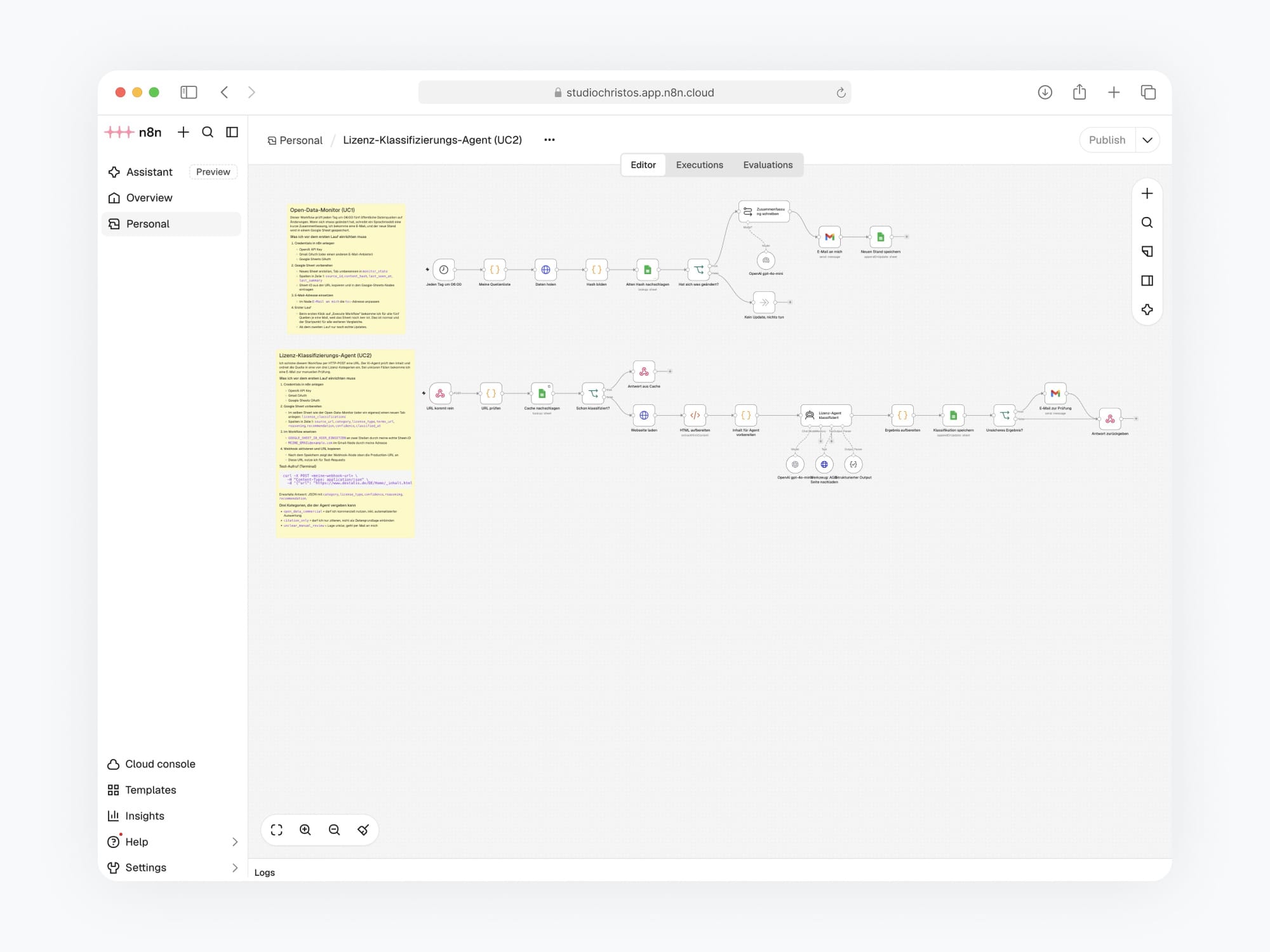
The result: new sources come in automatically, and I only check what's unclear.
The condition came from me: the workflow shouldn't cost money when nothing has changed.
I worked out how to do that technically together with the AI. The costs were only the trigger. A workflow that does nothing unnecessary also breaks less often and runs faster. That's how I work with artificial intelligence: I set the right condition up front, and the AI finds the way there.
I chose n8n because you can see and click on every step. Even someone who can't code can spot where it gets stuck. And I can explain the workflow in a few minutes and hand it over to a team that keeps it running on its own.
#2 Build the prototype: the frontend with agentic engineering
I built the entire interface with Claude Code.
To me, agentic engineering means: I set the direction and the rules, the AI agent writes the code, I check the result.
My training as an IT specialist helps me less with writing code than with reading it. I can see when the AI agent builds cleanly and when it's working right past the task.
The rules are written down in the project. There's a rulebook the agent reads before every task (CLAUDE.md), plus a tone of voice DNA for all copy and regular checks on whether the language is slipping. It came about after the agent had twice slid back into stock phrases without anyone noticing. Since then I write every rule down, so the AI agent and every team member work from the same basis.
The rulebook has a second purpose. A team can take over the system and keep it going, because the rules don't live only in my head. I know that principle from large corporations. At the insurer ERGO I built a design system with clear governance: who decides, who maintains it, how changes get in. At Protago AI it's the same, except this time an AI agent reads along.
#3 Set guardrails: legal, quality and costs from day one
Many projects build first and ask the legal department later. At ERGO I worked with the legal team on approving digital insurance products. Since then I bring the legal side in early. At Protago AI that means:
- Live: a notice that content is created with AI, a waitlist without its own database, and cookie-free analytics with Umami.
- Decided, implementation to follow: labeling directly on the AI result under Article 50, and clear rules on who is liable for which output.
- Against made-up facts: curated job profiles as a fallback when the AI gets unsure. The next step is for working people to review the profiles of their own jobs.
- Against runaway AI costs: a fingerprint comparison and caching before every AI model call, plus a deliberately small, cheap AI model for classification. The AI only gets paid when there's really something to do.
For the HR access I drew a line on purpose: Protago AI shows jobs and doesn't rate people. AI that helps decide on job applications or promotions counts as a high-risk system under Annex III of the EU AI Act. Protago AI deliberately stays below that threshold. That's practice from my own project, not legal advice.
#4 Enable people: the wording matters
The core principle of the platform: the human acts, AI is the tool. That's why “AI is changing your job” appears nowhere. “How you change your job with AI” does. In the first sentence the person watches. In the second they've got their hands on the wheel.
So there are four ways in: for individuals, HR, team leads and executives. Each group is addressed in its own language and gets its own recommendations. Under “Today” you'll find tools by name, prompts to copy, skills backed by a study and matching training courses. Things you can try out the same afternoon.

The same attitude is behind Hairy, the AI chatbot I trained for my startup wenighair. It answers more than 300 questions a month from six years of community knowledge. In both AI projects the tech was the easier part. The harder part is phrasing an answer so that someone actually uses it.
03 ✺ IMPACT
What's done, what's running, what comes next
- MVP live with beta testers, four ways in for HR, team leads, individuals and executives
- Research pipeline runs automatically: five sources watched daily, licenses checked, only unclear cases land with me
- AI model costs only come up when something changes, because before every call a check runs whether there's anything new at all
- Transparency notice and privacy-friendly analytics are live, labeling on the result and liability rules are set as the next step
Protago AI isn't finished, and that's on purpose. Protago AI is my test bed. I try out new tools and ways of working here before I use them in a team. I make the mistakes here first, at my own expense. A team then gets the version that already works.
There are also things I don't know yet. Today I can only estimate how the AI costs (in German) will behave once a lot more people use the platform. I'll measure it when we get there.
If you want to know how I set up AI projects, you don't have to take my word for it. A look at protagoai.com is enough.
04 ✺ WHAT THIS MEANS FOR YOUR COMPANY
I take AI from the idea into everyday work
I check every AI use case for the right tool first. Often a simple automation is enough, which saves budget and sources of error. I build AI prototypes myself, so your business team has something to try out after a few weeks. I plan for legal, data protection and costs from day one, together with the people in your organization who are responsible for them. And I write the rules down so the system doesn't depend on one person, me included.
The tech is the smaller part. I know the bigger part from my work since 2009 at the German retailer OTTO, ERGO, a digital venture of Dr. Oetker and HessenForst: understanding how people work today and showing them what AI concretely makes better. That's why I want to do this from the inside, as part of your team. Because most of the work only starts when the AI prototype is supposed to land in everyday work.
I tell the story of how I got here on my about page. And you can try Protago AI yourself right now.
Studio ✺ Christos
Are you building AI skills across your organization right now?
Tell me where you stand. If it's a good fit, I'll join your team and bring AI into your everyday work together with you.