300+ support requests a month on a sensitive topic: hair loss and going bald. I didn't want to brush people off with canned answers. So I turned everything I know into the knowledge base of an AI. Support scales. The system learns. I listen, with artificial intelligence as my ear. Since 2023.
✺ KEY FACTS
Project: wenighair AI chatbot "Hairy"
Timeline: In daily use since 2023
Challenge: Scale support on a sensitive topic and find content gaps
Role: System architect, prompt engineer, UX concept designer
Tech stack: RAG (retrieval-augmented generation), 500+ video transcripts and 100+ blog articles as the knowledge base
Impact: 300+ requests a month automated, 15-20 hours of support time saved, content planned from data
01 ✺ BUSINESS CHALLENGE
Hundreds of questions on a sensitive topic, with no team and no canned answers
Hair loss is personal. People google, click through FAQ pages and find generic answers. "Hair loss can have many causes." Wow, who knew.
At wenighair I had a different problem. Not too little traffic. Not too little interest. Too many individual questions, more than I could answer on my own without my whole day turning into support.
Most people would say: "Build a support team." Or: "Write a better FAQ." Both make no sense when you're a one-person startup and have documented your expertise in videos, articles and podcasts since 2019.
I wanted two things at once:
- Really help people with a sensitive topic (instead of brushing them off with copy-and-paste answers)
- Understand which questions keep coming back (so I can create better content)
A classic support chatbot does neither well. It fends off requests. It hands out generic text blocks. And it tells you nothing about what your community really needs.
So I built something else.

02 ✺ SOLUTION
A system that learns, instead of a standard chatbot
I didn't want a chatbot that fends off requests. I wanted an open ear.
So I took all my expertise from hundreds of articles and the transcripts of 500+ videos and podcasts and made it the knowledge base of an artificial intelligence.
The goal: real help through AI instead of canned answers.
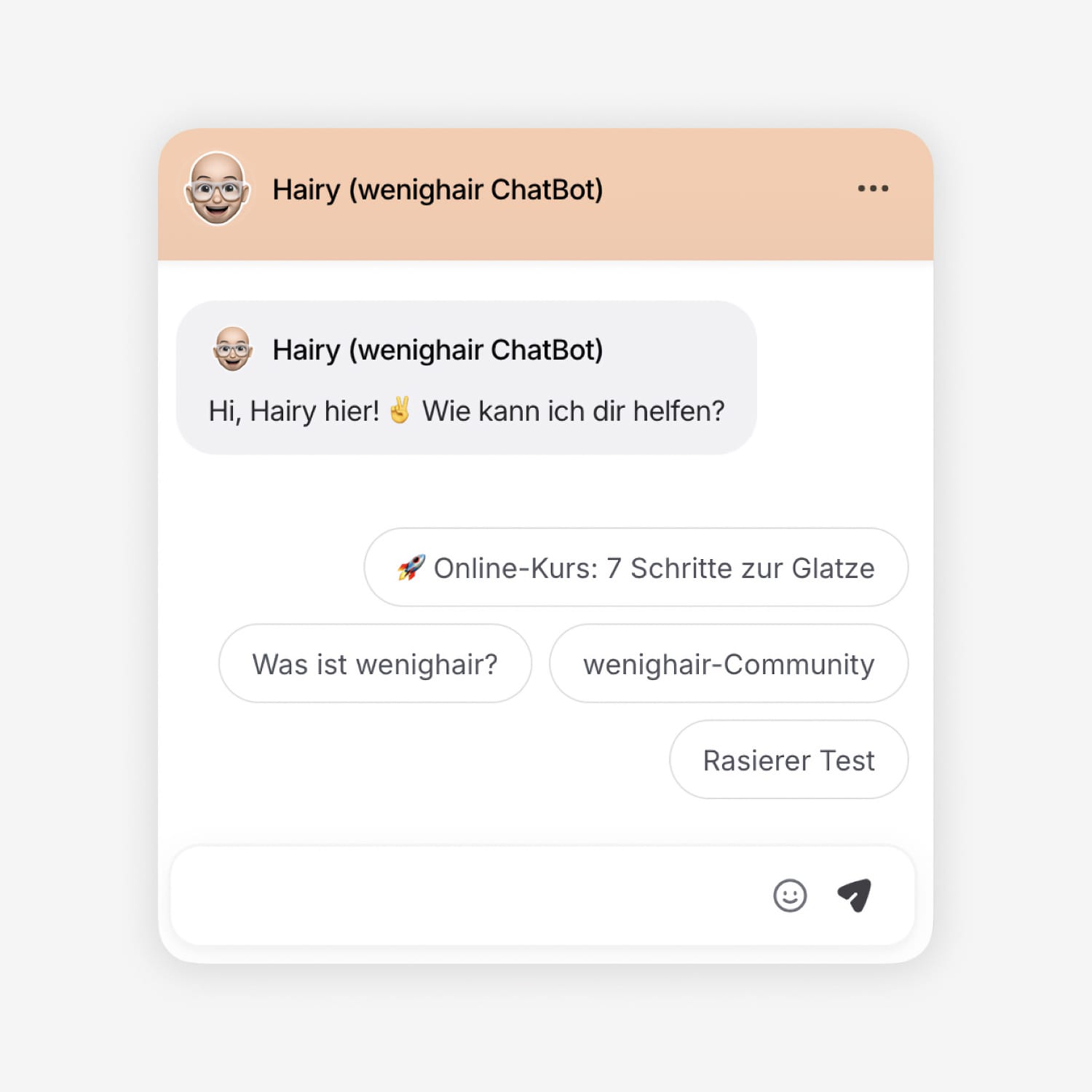
#1: Scaling support with trained knowledge
500+ video transcripts. 100+ blog articles. Everything I've learned and written down about hair loss, going bald and self-confidence since 2019 became the foundation.
No generic phrases from the internet. My experience, my tests, my honest answers. The AI searches my entire knowledge archive and gives answers that fit the context, instead of copy-and-paste lines.
My UX experience helped me understand one thing: people don't want to be processed. They want to be understood.
The result? People get answers based on years of work. And I save 15-20 hours of support work a month. Several working days that I now put into my data-driven product development instead of email ping-pong.
#2: My digital ear: content gaps from data instead of gut feeling
But the chatbot is more than a support tool. It's a feedback channel.
I used to think I knew what my community needed. Today the community shows me what it needs. Every day.
- Where are my content gaps?
- What's really on people's minds?
- Which questions keep coming back?
The answers come from "Hairy", my AI chatbot.
No more guessing. No more content planning by gut feeling. Data from real questions instead. People ask. The chatbot answers. I see the patterns.
What came out of it: 10+ blog articles based directly on the most common questions. Videos on topics that came up a hundred times. I then built these articles for SEO as part of my growth marketing, from real user questions instead of keyword tools.
#3: The loop: questions → content → system
New questions lead to new articles. Those articles go back into the system. The chatbot gets better. The answers get more precise. The system learns along the way.
A loop that has been running every day since 2023:
- People ask
- The chatbot answers (from existing knowledge)
- I spot content gaps
- I create new content (blog, video, whatever fits)
- The new content goes into training
- Back to step 1
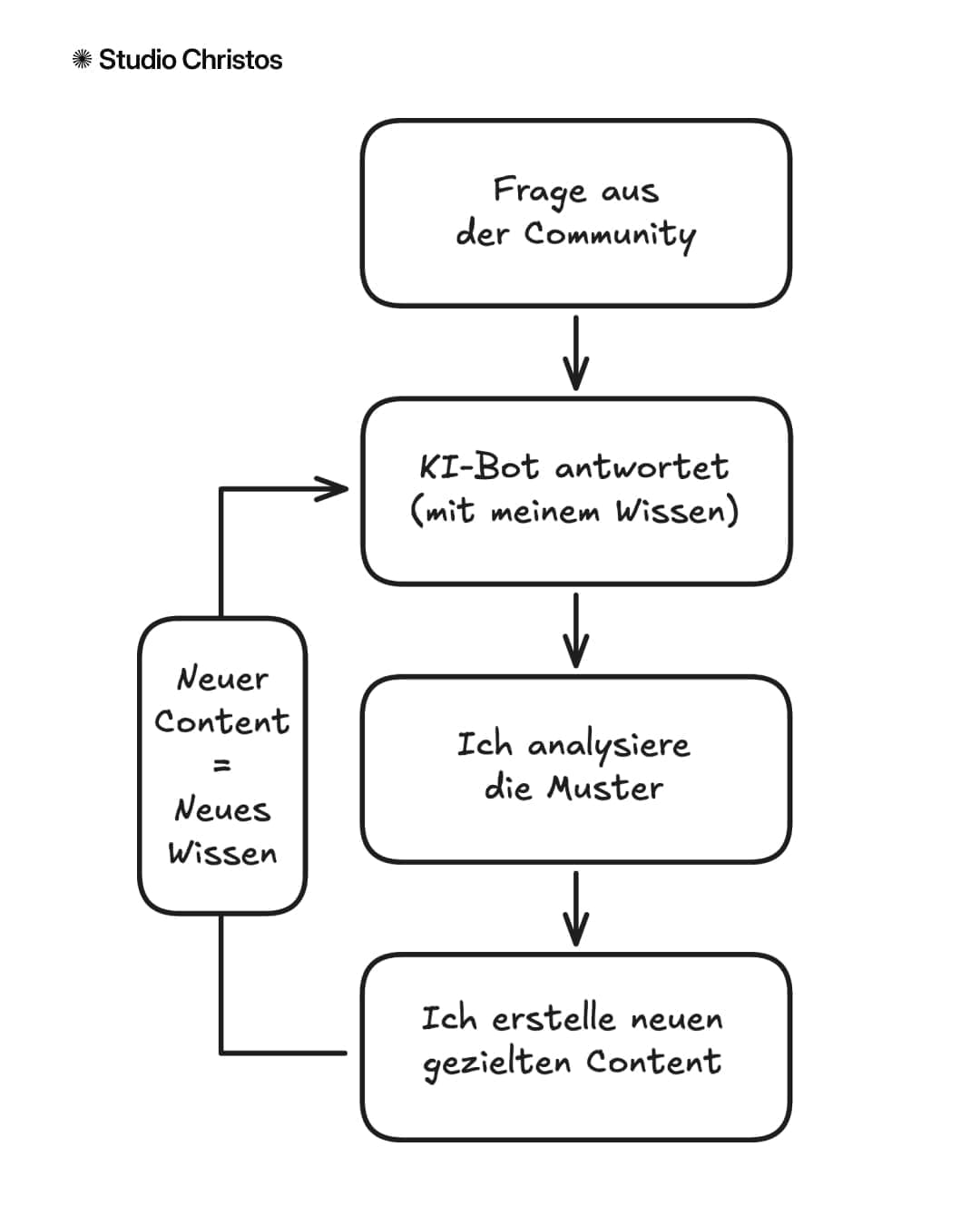
No more content planning based on "What might be interesting". I plan from what people actually ask.
03 ✺ IMPACT
Time saved, gaps found, better help
The numbers are clear:
- 300+ support requests automated every month
- 15-20 hours of support time saved (several working days)
- 10+ blog articles created from real user questions
- Content roadmap now based on data instead of assumptions
But the real effect is somewhere else.
People get better answers. Not faster ones. Not more efficient ones. Better ones. Because the AI draws on everything I know, not only the three points I could have squeezed into an FAQ.
And I create better content. No longer by feel: "That might be interesting", but by facts: "This question came up 47 times, time for an article."
Data-driven decisions instead of gut feeling. That's also how I develop my online courses for the largest German-speaking bald community.
No marketing speak. Most creators make content by intuition. I make content from data.
04 ✺ TAKEAWAYS

1. Building systems beats hopping between tools
The difference between "I use ChatGPT for support" and "I built an AI system": one scales, the other doesn't.
Anyone can use a tool. Few people build systems that solve two problems at once. Automating support AND finding content gaps isn't a feature request. That's strategic design.
2. UX thinking is the lever in AI integration
Anyone can buy technology. But designing AI systems around the people who use them? That takes an understanding of people, not of APIs.
My user experience background helped me more than any tutorial. Because I never started with "Which AI technology should I pick?" I started with "How do I help people better?"
3. Training in real time: the system keeps learning
Most people think: train it once and it runs. Wrong. A good AI system is a loop:
Questions → answers → analysis → new content → training → better answers.
If your system doesn't learn, you don't have a system. You have a database that talks.
4. Technology lets empathy scale
Artificial intelligence can talk to a hundred people at once. But it talks with my voice, my experience, my understanding.
That's the difference between an annoying AI chatbot and a useful one: what you put in. And whether you're willing to really help instead of just answering.
5. The uncomfortable part: it takes real knowledge
If you aren't willing to share your knowledge, the real, imperfect, honest kind, you don't need an AI chatbot. You need an FAQ.
The technology isn't the problem. The problem is whether you're willing to offer real help instead of marketing phrases.
Does your support answer the same ten questions every day?
Tell me which questions keep coming in. Then we'll look together at what AI can take over, and I'll take care of it as part of your team.