
Claude is the AI assistant made by Anthropic, an AI company in San Francisco founded in 2021 by former OpenAI employees. You chat with Claude in the browser at claude.ai or in the desktop and mobile apps, or you let it work as an agent, for example with Claude Code. Behind the name is a family of language models: Haiku 5.5, Sonnet 5.5, Opus 5.5 and, above them, Fable 5.2 (Anthropic model overview, November 2026). The Free plan gives you Sonnet and Haiku, Pro costs $20 a month before tax.
What is Claude?
Claude is an AI assistant you talk to in plain language, and at the same time the name of the language models that do the work behind it. A language model is, roughly speaking, a program that has learned from a huge amount of text how language continues, and so it can build a fitting answer to your question.
A lot of people type exactly that question into Claude. Maybe you did too, a minute before you landed here. It's a bit like asking the new colleague who the new colleague is. He knows. He'll happily tell you, too, just in more detail than you wanted.
I've written more than a dozen articles about Claude on my German blog by now. So if you know someone who won't stop talking about Claude over lunch: that's probably me. Feel free to check your phone. Claude is my thinking partner when I write, plan or build. Still, the honest answer to the simple question is confusing, because Claude is four things at once today.
Okay, four isn't quite right either. Depending on how you count, it's more. I'll stick with four. Four you can remember.
One name for four things
When someone says “Claude” today, they mean one of these four things, usually without noticing:
- The models: Haiku, Sonnet, Opus and Fable do the thinking in the background. They're the engine, the other three are the workshops it runs in.
- The chat: claude.ai in the browser and the apps for desktop and phone. This is where you ask questions, upload PDFs and spreadsheets and get answers, texts or small programs back.
- Claude Code: an agent that works inside a project folder, changes files and runs commands. Built for software, websites and automations. What that looks like day to day is in What is Claude Code?.
- Claude Cowork: the same idea for knowledge work without code. Claude works in folders you share and leaves finished files for you to check. More in What is Claude Cowork?.
Then there are smaller building blocks. With Claude Skills you explain once how you handle a task, and you don't have to repeat it in every chat. Through the API, companies build Claude into their own software and pay for what they use.
| Claude part | What it's for | From which plan |
|---|---|---|
| Chat (web and apps) | questions, writing, working with files | Free |
| Skills | saving your own workflows | Free |
| Claude Code | software, websites, scripts | Pro |
| Claude Cowork | research, analysis, documents | Pro |
| API | building Claude into your own software | pay per use |
Plans as listed on the Claude pricing page and the Cowork page, November 2026.
To get started you need exactly one row of that table, the first one. I'd start with the chat and only move on when it hits a limit that really bothers you. For me, that limit was this website. For you it might be a spreadsheet you copy together by hand every Monday. And honestly, plenty of people stay with the chat forever. That's completely fine. In a team I'd do it the same way: the chat for everyone first, then Claude Code for the few who actually build something.
Which Claude models are there?
Anthropic currently offers four Claude models: Haiku 5.5, Sonnet 5.5, Opus 5.5 and Fable 5.2 (Anthropic model overview, November 2026).
| Claude model | Good at | API per 1M tokens |
|---|---|---|
| Fable 5.2 | hard reasoning, long agent work | $8 input, $40 output |
| Opus 5.5 | knowledge work and code over hours | $4 input, $20 output |
| Sonnet 5.5 | everyday work, fast and good | $2 input, $10 output |
| Haiku 5.5 | high volume: sorting, extracting | from $0.10 input, from $0.50 output |
All four read text and images and have a context window of one million tokens. That's how much text Claude keeps in view at once in a conversation. On a subscription you don't pay per token, the usage limit is what counts there. If you're unsure, Anthropic suggests starting with Opus 5.5.
The names sound like a literature seminar, and somehow that fits. Opus is the big work, a sonnet is a medium-length poem, a haiku is three lines. Fable came later, and I still haven't found a good way to remember it. A fable has a moral at the end. Maybe that's the idea. Maybe someone at Anthropic just likes books.
And the name Claude itself? According to Wikipedia, some Anthropic employees believe it's a nod to Claude Shannon, the mathematician behind information theory. Believe, mind you. Nice story. I still wouldn't put it on a slide.
Anthropic introduced the very first Claude on March 14, 2023. In Europe, where I live, claude.ai has been available since May 2024. Since then a new version number arrives every few months, while the roles of the sizes stay the same.
What I use Claude for every day
I work with Claude every day, but not for everything. Quick questions and images go to ChatGPT, anything around Google to Gemini. That has little to do with loyalty and a lot to do with dividing the work. On a normal day, Claude gets roughly this from me:
- Texts under my name. For these I use Opus and ask it to flag uncertain statements instead of smoothing them over. A clumsy sentence with an honest flag beats a smooth one with a wrong number.
- Drafts, outlines, Excel formulas. Sonnet does those, quickly and without drama.
- The website you're reading. I build it with Claude Code. Every change goes through a pull request with an automatic check before it goes live.
- Repetitive sorting. That goes to Haiku, the smallest model, which I ignored for far too long.
Sounds like a very hard-working colleague. It is. Still, some steps belong to a person on purpose, with a name and their own approval. With a draft that's harmless. With a bank transfer or a termination letter it's the most important step in the whole process.
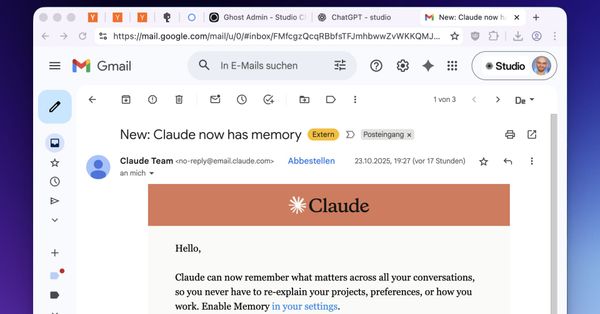
Claude also remembers things across chats if you let it. I'm a little skeptical about that one, because I like to know what an answer is built on. What it stores and where I switch it off is in Claude memory.
 Christos Stavrou
How much does Claude cost?
Claude costs between $0 and $200 a month for individuals, before tax (Claude pricing page, November 2026). The plans at a glance:
- Free: $0, with Sonnet and Haiku and a limit every five hours and per week.
- Pro: $20 a month, or $17 billed annually, with Opus and Claude Code.
- Max: $100, more usage and Fable up to half of the weekly limit.
- Ultra: $200, the biggest plan for individuals.
- Team: $25 per seat a month for a Standard seat, $20 billed annually.
My rule of thumb is simple. Start with Free. If you hit the limit several times in one week, it's time for Pro. Anything above that only pays off, in my experience, if you really build a lot with Claude. All plans and limits in detail are in my guide to Claude pricing.
One row on the pricing page most people skip: for model training, Free, Pro, Max and Ultra say “Opt-out”. If you don't want your conversations used for training, you have to switch it off in the settings yourself. For companies I find this one of the strongest reasons for the Team plan, because there Anthropic doesn't train on your content by default. In the EU, it's often the first thing a data protection officer asks about.
Where Claude lets you down
Claude writes well. Sometimes so well that you forget to check. These are the limits I mention to anyone who's just starting:
- Claude can be wrong and sounds just as sure as when it's right. I check numbers, names and legal paragraphs at the source. Always.
- Its knowledge has a date. According to Anthropic, the current models know the world reliably up to June 2026. For anything later, Claude has to search the web.
- One pot for everything. Chat, apps and Claude Code draw from the same limit. If you build a lot, you tend to notice in the middle of the week.
- Image generation isn't on Claude's pricing page. For that I use ChatGPT.
None of that is a reason to skip it. It's a reason to read before you send.
What Claude won't take off your hands is the decision about what goes out.
That one stays yours. Which is better, Claude or ChatGPT, depends almost entirely on the task. My side-by-side is in Claude vs ChatGPT. I find Claude the best colleague right now for anything with long texts and documents. For quick lookups it's often too thorough for me. I want one sentence and get three paragraphs.
And if you've been wondering since the news: Anthropic has been on the stock market since November 19, 2026. For you as a user, that changes nothing for now. Your plan and your chats stay the same.
Day one, you ask the new colleague who he is. Day two, you'd better ask him to take a quick look at that Monday spreadsheet. That's where it starts to pay off. Usually until Thursday, when the weekly limit runs out.
Studio ✺ Christos
Frequently asked questions
What is Claude AI used for?
Claude writes, summarizes, translates, analyzes PDFs and spreadsheets and writes code. With Claude Code and Claude Cowork it also completes tasks by itself in folders you share and leaves the result for you to check. You describe the task in plain language.
Is Claude free?
Yes. The Free plan costs nothing and includes the Sonnet and Haiku models, with a limit every five hours and per week. Opus and Claude Code start with Pro at $20 a month before tax, according to the Claude pricing page (November 2026).
Who owns Claude?
Claude belongs to Anthropic, a public benefit corporation in San Francisco founded in 2021 by former OpenAI employees, among them the siblings Dario and Daniela Amodei. Since November 19, 2026, Anthropic shares trade on the Nasdaq under the ticker ANT.
Is Claude better than ChatGPT?
It depends on the task. Claude is strong with long texts, documents and code. ChatGPT also generates images, which Claude's pricing page doesn't list. Many people use both and split the work between them.
Is Claude safe to use?
Claude is a regular cloud service from Anthropic. It can be wrong while sounding sure, so check numbers, names and legal details at the source. On Free, Pro, Max and Ultra, training on your chats is on until you opt out in the settings. On the Team plan, Anthropic does not train on your content by default.
