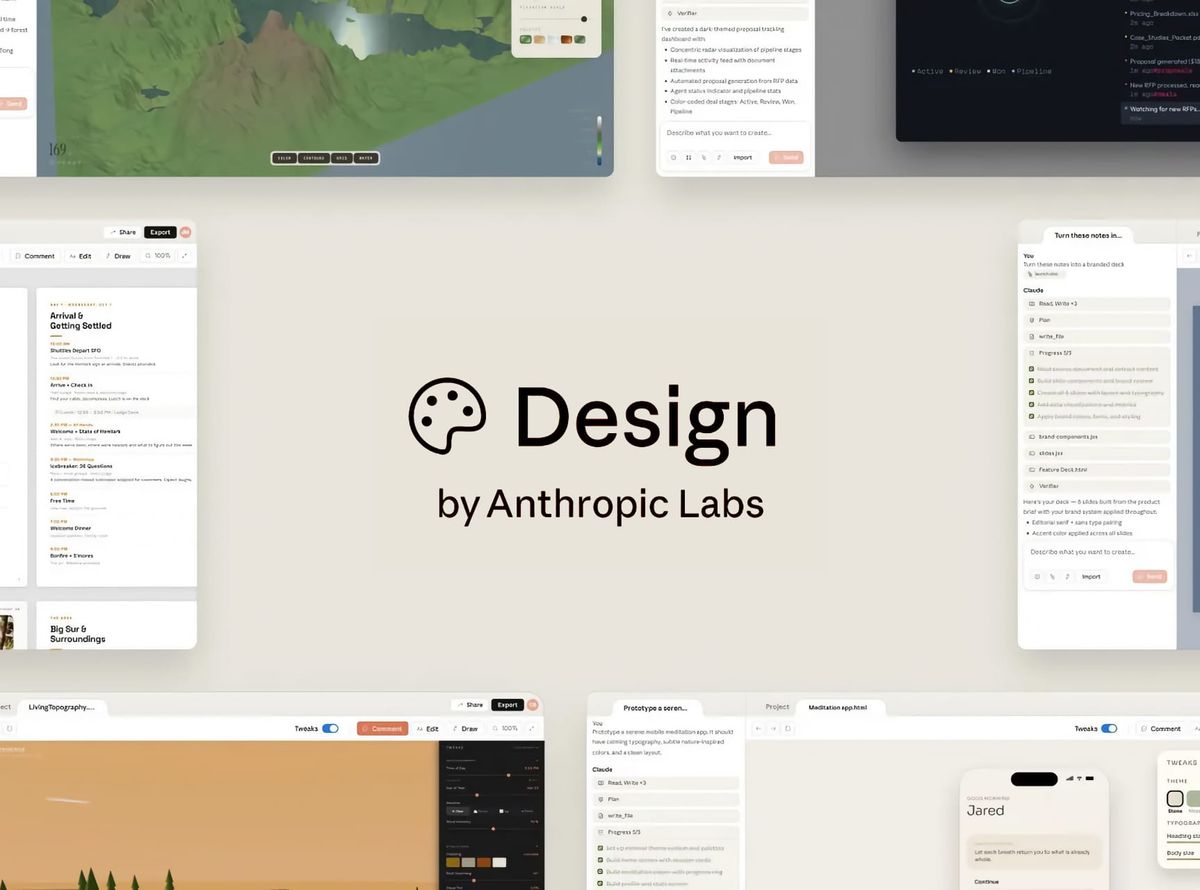
Claude Design is an AI tool from Anthropic that turns a description into prototypes, slides and landing pages, follows a team's design system and hands finished designs to Claude Code. It launched on April 17, 2026 as a research preview from Anthropic Labs and now lives inside Claude chat, the Artifacts tab and Claude Code. According to Anthropic it is included in every plan, Free too, and draws from the normal usage limits (Help Center, November 2026). On launch day, Figma's stock fell about 7 percent (The Motley Fool, with S&P Global data).
What is Claude Design?
Claude Design is the part of Claude that builds designs on a canvas next to the chat: clickable prototypes, slides and landing pages. Anthropic introduced it on April 17, 2026, running on Opus 4.7, with a twist that matters to anyone who has worked in a design team. During setup, Claude reads your codebase and design files and builds a design system from them. Later projects use its colors, type and components by themselves.
I've worked in design since 2009, and several of those years went into exactly that: design systems. So here's the contradiction I keep running into. The slow part of my work in large companies, Claude Design now claims to do during onboarding. And I'm not panicking.
Since September 2026, Claude Design no longer needs its own page. It works inside every conversation, next to Claude Cowork and the new Docs and Slides. The old standalone version at claude.ai/design closes on December 14, 2026, so if you still have projects or a design system there, move them before that date (Anthropic).
The day Figma fell
Friday, April 17. Anthropic launches Claude Design, and Figma's stock falls 7 percent. By the end of April it's down 16 percent, though Claude Design wasn't the only Anthropic news that month, according to S&P Global Market Intelligence data cited by The Motley Fool. On Hacker News, designers and developers argue about whether this is the beginning of the end.
The perfect moment for a proper career crisis, really. Stare dramatically at the sea, whisper “was that it?”, maybe open Figma in dark mode like a memorial candle.
I didn't. The question going around, “Will AI replace designers?”, is about as old as my first MacBook by now. I think it's asked the wrong way, for the same reason as the question about programmers: it counts the tasks and forgets the decisions.
How do you use Claude Design?
You describe what you need, give Claude your design system and some material, and refine the draft in the chat or directly on the canvas. Claude Design draws from the same usage pot as the chat and Claude Code, there's no separate allowance (Anthropic Help Center). No dedicated button to hunt for. It sits in four places:
| Where | How you start |
|---|---|
| Chat | ask for a design, or pick Output, Design in the message box |
| Artifacts tab | choose a design template |
| Claude Code | ask for a design or type /design |
| iPhone and Android app | request a design in any conversation, view and edit it under Artifacts |
Sharing settings can only be changed on the web or the desktop. Anthropic describes seven steps. I boil them down to five:
- Start in the chat or the Artifacts tab.
- Add a design system. In organizations it's often set up already and new projects pick it up. To bring your own, run /design-sync in Claude Code and point it at a GitHub repository, design files or a local codebase.
- Attach material: screenshots, sketches, existing slides or a code repository, so Claude knows your building blocks.
- Describe the goal, structure, content and audience. The more precise the briefing, the fewer rounds.
- Refine and hand off. Big changes in the chat, small ones as a comment on the spot or directly on the canvas. Export as ZIP, PDF, PPTX, Google Slides or standalone HTML, or send it to tools like Canva, Miro, Adobe, Vercel or Wix. For the build, you hand the design to Claude Code.
Before the first real project I'd know three limits. There's no version history yet. When several people edit the same design at once, that's basic and may not work reliably. And inline comments sometimes don't show on the canvas, which is when the oldest trick in the world helps: paste the feedback into the chat. And Figma? Still not on the export list in November 2026. I noticed that back in April, and my question mark can stay.
The case against Claude Design
On Hacker News, designers go after Claude Design with the “AI slop” charge: uniform cards, rounded corners, always the same dark mode. One user writes, roughly, that the tool produces competent interfaces without a soul.
I take that seriously. It's real, and it's human. Most AI interfaces I see do look like the same landing page with a bit more corner radius. If your idea of design is the surface, Claude Design looks like a threat and a downgrade at the same time.
But the surface was never where the time went. At least not in my projects.
What a design system really is
At ERGO, an insurance group that's more than a hundred years old, the design system I helped build grew to hundreds of components. Later I did it again for a Dr. Oetker digital venture. In both cases the components weren't the hard part. The hard part was that every department spoke its own language, and the design system became the one they shared. Each component was a decision teams no longer had to make again. You can read the longer version in my CV.
For a single slide or a quick diagram you don't need a design system at all, by the way. A question in the chat is enough. The system pays off once several people build drafts that should look like you. And that's exactly where the real work in a company starts: who maintains it, who signs off?
So when Claude Design reads a codebase and turns it into a system, it does what is, to me, the part that's easiest to explain and slowest to type. What it doesn't do:
- decide which of two button styles the company really wants
- get marketing and product to agree on that decision
- say who maintains the system after launch, and who approves changes
- notice when a component exists only because one stakeholder was loud
What changed in my work
A small example, without giving away too much, because it's all still in beta. I built a draft in Claude Design, handed it straight to Claude Code and built it into a running project.
What would have taken a briefing, two meetings and three rounds of feedback two years ago was done in an hour.
That's the part the stock chart doesn't show. Three things have shifted in my everyday work:
- Prototyping went from about 60 percent of my work to maybe 20.
- Decision work grew: what gets built, what doesn't, and why.
- The most interesting problems are now about systems, less about screens.
Anthropic shipped Opus 4.7 and Claude Design in the same week, and has kept that pace since. Impressive and exhausting at once. I don't know where this ends up. Nobody does. And the designers who are retraining or leaving the field right now, I understand them. Really.
What's left when execution stops being a superpower? For me the answer is fairly clear: judgment, direction, taste. Picking the one right thing out of ten possible ones, instead of building one more pretty interface that looks like all the others with a little more radius.
Panic isn't a plan. So I've stopped asking whether AI will replace designers. The question I'd put on the table in any team instead: who decides which of the ten drafts ships?
Studio ✺ Christos
Frequently asked questions
What is Claude Design?
Claude Design is a tool from Anthropic that builds prototypes, slides and landing pages from a description and follows a team's design system. It launched on April 17, 2026 and has worked inside Claude chat, the Artifacts tab and Claude Code since September 2026.
Is Claude Design free?
Yes, according to Anthropic it is included in every plan, including Free, Pro, Max, Ultra, Team and Enterprise. It has no separate allowance and counts toward your plan's normal usage limits (November 2026).
How do I use Claude Design?
Ask Claude for a design in the chat or pick Output, Design in the message box, attach material like screenshots or a repository, and refine the draft in the chat, by comment or on the canvas. You can export it as PDF, PPTX, Google Slides, HTML or ZIP, or hand it to Claude Code.
Can Claude Design export to Figma?
Not directly, as of November 2026. The export options are ZIP, PDF, PPTX, Google Slides and standalone HTML, plus tools like Canva, Miro, Adobe, Vercel and Wix. Figma is not on the list.
Will Claude Design replace designers?
In my view, no. It takes over a lot of execution, and in my own work prototyping shrank from about 60 to maybe 20 percent. Judgment, direction and taste count more: choosing the right solution out of ten possible ones.